Eka, M. E. B. (2025). Evaluation of the Impact of Polystyrene Leachates from Food Containers on Serum Lipid Profile in Normal Albino Rats. Equatorial Journal of Science, Education and Technology, 9: 6-9
DOI: https://doi.org/10.5281/zenodo.16908204

📑 Citation
Title: Evaluation of the Impact of Polystyrene Leachates from Food Containers on Serum Lipid Profile in Normal Albino Rats
Author(s): Moses Eso Bassey Eka
Year: 2025
Journal: Equatorial Journal of Education, Science and Technology, Volume 9, pages 6–9
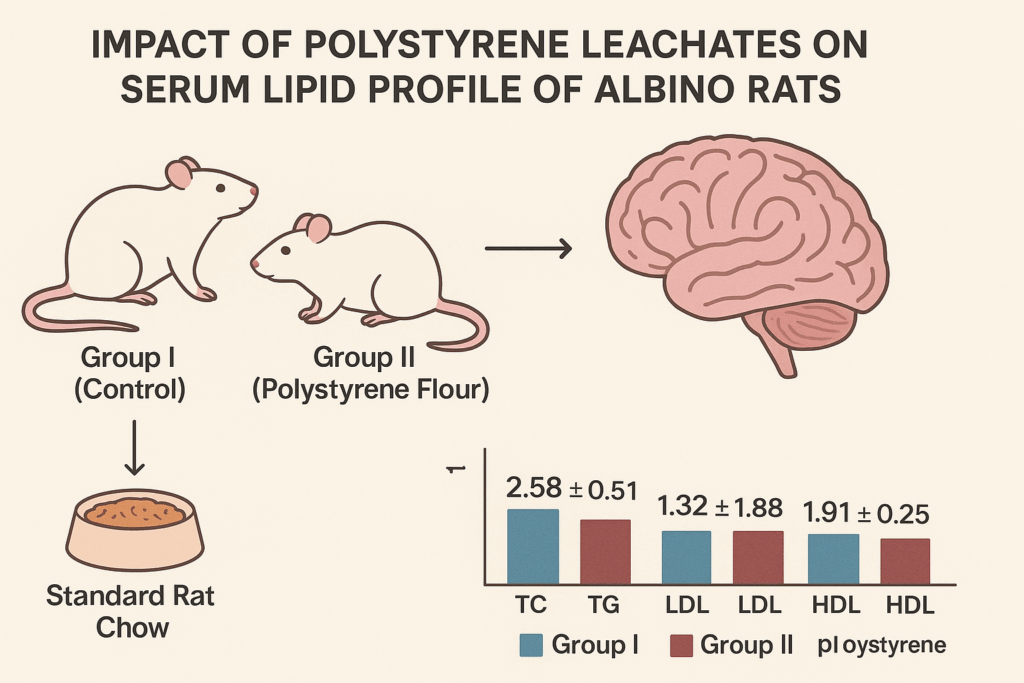
| ABSTRACT: This study evaluates the impact of polystyrene leachates, administered in the form of polystyrene flour blended into standard rat chow, on the serum lipid profile of normal albino rats, with a specific focus on brain lipid composition. Experimental animals were divided into two groups: Group I (control) received standard rat chow, while Group II was fed chow formulated with polystyrene flour. Lipid analysis revealed that Group II exhibited elevated levels of total cholesterol (TC: 3.01 ± 1.79 µg/mg protein), triglycerides (TG: 1.32 ± 1.88 µg/mg protein), and low-density lipoprotein (LDL: 1.91 ± 0.25 nM/mg protein), alongside a slight reduction in high-density lipoprotein (HDL: 1.30 ± 1.09 mol/mol) compared to the control group (TC: 2.58 ± 0.51, TG: 1.00 ± 2.51, LDL: 1.25 ± 5.21, HDL: 1.39 ± 2.11). These alterations suggest that dietary intake of polystyrene may disrupt lipid metabolism, possibly compromising neuroprotective mechanisms and contributing to lipid imbalances linked to neurodegenerative conditions. The findings underscore the need for further investigation into the long-term effects of dietary contaminants on brain lipid homeostasis and support the development of dietary regulations that limit exposure to synthetic food packaging-derived compounds |
Keywords: Polystyrene leachates; Serum lipid profile; Albino rats; Food packaging; Lipid metabolism
REFERENCES
Ajaj, A., J’Bari, S., Ononogbo, A., Buonocore, F., Bear, J. C., Mayes, A. G., & Morgan, H. (2021). An insight into the growing concerns of styrene monomer and poly (styrene) fragment migration into food and drink simulants from poly (styrene) packaging. Foods, 10 (5), 1136.
Ghoshal, T., Parmar, P. R., Bhuyan, T., & Bandyopadhyay, D. (2023). Polystyrene foams: Materials, technology, and applications. In Polymeric Foams: Fundamentals and Types of Foams (Volume 1) (pp. 121-141). American Chemical Society.
Obuzor, G. U., & Onyedikachi, U. B. (2023). Chemical leaching into food and the environment poses health hazards. In Modernity in health and disease diagnosis: The account from STEM women (pp. 129-148). Cham: Springer Nature Switzerland.
Sørensen, L., Gomes, T., Igartua, A., Lyngstad, I. L., Almeida, A. C., Wagner, M., & Booth, A. M. (2023). Organic chemicals associated with rubber are more toxic to marine algae and bacteria than those of thermoplastics. Journal of Hazardous Materials, 458, 131810.
Wu, Y., Li, Z., Shi, L., Zhu, Y., Wang, Y., Yan, N., & Li, J. (2024). Effects of leachate from disposable plastic takeout containers on the cardiovascular system after thermal contact. Ecotoxicology and Environmental Safety, 288, 117383.
Fritsche, K., Ziková-Kloas, A., Marx-Stoelting, P., & Braeuning, A. (2023). Metabolism-disrupting chemicals affecting the liver: screening, testing, and molecular pathway identification. International Journal of Molecular Sciences, 24(3), 2686.
Symeonides, C., Aromataris, E., Mulders, Y., Dizon, J., Stern, C., Barker, T. H., ... & Dunlop, S. (2024). An umbrella review of meta-analyses evaluating associations between human health and exposure to major classes of plastic-associated chemicals. Annals of Global Health, 90(1), 52.
Proietti, M. (2025). Genotoxic effects of plastic leachates and plastic-related chemicals, Bisphenol A (BPA) and perfluorooctanoic acid (PFOA), in Drosophila melanogaster.
Eka, M. E. B. (2025). The Role of Polyethylene Leaching on Liver and Renal Function: Investigating Serum LDH and ALP Levels in Albino Wistar Rats. Equatorial Journal of Education, Science and Technology, 9: 1-5
Kosmas, C. E., Rodriguez Polanco, S., Bousvarou, M. D., Papakonstantinou, E. J., Peña Genao, E., Guzman, E., & Kostara, C. E. (2023). The triglyceride/high-density lipoprotein cholesterol (TG/HDL-C) ratio as a risk marker for metabolic syndrome and cardiovascular disease. Diagnostics, 13(5), 929.
Liu, H., Li, P., Zhou, T., Yu, Z., Zhang, W., Zhu, Y., ... & Weng, D. (2025). Exposure to leachates of plastic food containers disturbs glucose and lipid metabolism: Insights from models mimicking real-exposure scenarios. Ecotoxicology and Environmental Safety, 289, 117498.
Vashishat, A., Patel, P., Das Gupta, G., & Das Kurmi, B. (2024). Alternatives of animal models for biomedical research: a comprehensive review of modern approaches. Stem Cell Reviews and Reports, 20(4), 881-899.
Folch, J., & Lees, M. (1951). Proteolipides, a new type of tissue lipoproteins: Their isolation from brain. Journal of Biological Chemistry, 191(2), 807-817.
Gottfried, E. L., & Rapport, M. M. (1962). The Biochemistry of Plasmalogens: I. Isolation and characterization of phosphatidal choline, a pure native plasmalogen. Journal of Biological Chemistry, 237(2), 329-333.
Pfrieger, F. W. (2003). Role of cholesterol in synapse formation and function. Journal of Cell Science, 116(23), 4785-4794.
Ramírez-Melo, L. M., Estrada-Luna, D., Rubio-Ruiz, M. E., Castañeda-Ovando, A., Fernández-Martínez, E., Jiménez-Osorio, A. S., ... & Carreón-Torres, E. (2025). Relevance of Lipoprotein Composition in Endothelial Dysfunction and the Development of Hypertension. International Journal of Molecular Sciences, 26(3), 1125.
Gallagher, I., Li, Y., Youn, C., Tanaka, H., Davis, J. N., & Haley, A. P. (2025). Dietary Saturated Fat Intake Moderates the Effect of Plasma Triglycerides on Memory Performance in Middle-Aged Adults. Nutrition and Dietary Supplements, 29-41.
Saito, I., Yamagishi, K., Kokubo, Y., Yatsuya, H., Iso, H., Sawada, N., ... & Tsugane, S. (2020). Non-high-density lipoprotein cholesterol and risk of stroke subtypes and coronary heart disease: the Japan public health center-based prospective (JPHC) study. Journal of atherosclerosis and thrombosis, 27(4), 363-374.
Views: 10