The Role of Polyethylene Leaching on Liver and Renal Function: Investigating Serum LDH and ALP Levels in Albino Wistar Rats, Equatorial Journal of Education, Science and Technology (2025), Volume 9: Pages 1-5
DOI: https://doi.org/10.5281/zenodo.16274193
Moses Eso Bassey Eka 
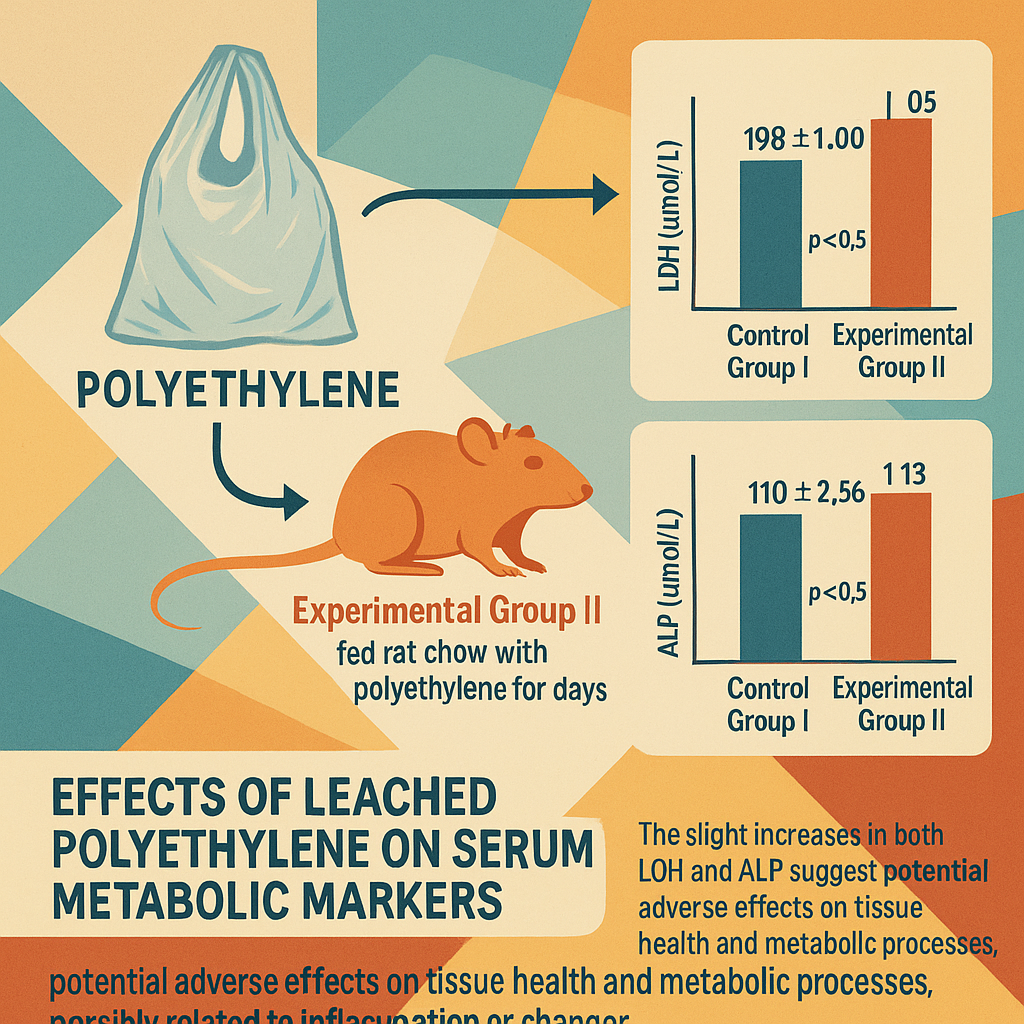
Abstract: Polyethylene or polythene is the most commonly produced plastic. It is a polymer, primarily used for packaging. This study investigates the effects of leached polyethylene on serum lactate dehydrogenase (LDH) and alkaline phosphatase (ALP) levels as indicators of tissue health and metabolic function. Rats were divided into two groups, with group I (Control), fed normal rat chow without exposure to polyethylene (n=10), and group II (Experimental groups) fed with normal rat chow with leached polyethylene for 30 days (n=10) supplemented with polyethylene formulations. Result shows that Group I, LDH levels were measured at 198 ± 1.00 (µmol/L), while ALP levels were 110 ± 2.56 (µmol/L). In contrast, Group II exhibited a slight increase in LDH to 200 ± 3.25 (µmol/L) and ALP to 113 ± 2.11 (µmol/L) at (p<0.05). The elevated LDH levels in Group II suggest potential tissue stress or damage, indicating that leached polyethylene may adversely affect cellular integrity. Similarly, the increase in ALP levels may reflect alterations in liver function or bone metabolism, further suggesting metabolic disturbances associated with polyethylene exposure. The data indicate that leached polyethylene has a measurable impact on serum metabolic markers in Experimental Group II. The slight increases in both LDH and ALP suggest potential adverse effects on tissue health and metabolic processes,possibly related to inflammation or changes in cellular function. The findings from this research highlight the potential physiological impacts of leached polyethylene on serum metabolic markers, indicating a need for further research to explore the underlying mechanisms and long-term health implications of exposure to such materials. The results contribute to the understanding of how common plastic materials used mostly in packaging can affect biological systems, emphasizing the importance of evaluating their safety in animal models.
Key words: Polyethylene Leaching; Liver Function; Renal Function; Serum LDH; Serum ALP
References
Ajaj, A., J’Bari, S., Ononogbo, A., Buonocore, F., Bear, J. C., Mayes, A. G., & Morgan, H. (2021). An insight into the growing concerns of styrene monomer and poly (styrene) fragment migration into food and drink simulants from poly (styrene) packaging. Foods, 10(5), 1136.
Altahrawi, A. Y., James, A. W., & Shah, Z. A. (2025). The Role of Oxidative Stress and Inflammation in the Pathogenesis and Treatment of Vascular Dementia. Cells, 14(8), 609.
Alwutayd, K. M., Aqeel, M., Khalid, N., Nawaz, S., Akhter, N., Irshad, M. K., ... & Noman, A. (2025). Microplastic Contaminated Root Zone Supplementation With Ascorbic Acid Enhance Photosynthesis, Antioxidant Defense, ROS Scavenging, and Secondary Metabolites in Rice. Journal of Soil Science and Plant Nutrition, 1-17.
Banaee, M., Zeidi, A., Gholamhosseini, A., Shakeri, R., Faggio, C., & Multisanti, C. R. (2025). Potential synergistic effects of microplastics and zinc oxide nanoparticles: biochemical and physiological analysis on Astacus leptodactylus. Ecotoxicology, 1-10.
Huang, H. J., Liu, Y., Li, D. W., Wang, X., Feng, N. X., Li, H. Y., ... & Yang, W. D. (2025). Polystyrene Microplastics Can Aggravate the Damage of the Intestinal Microenvironment Caused by Okadaic Acid: A Prevalent Algal Toxin. Marine Drugs, 23(3), 129.
Kim, J.-H., Yu, Y.-B., and Choi, J.-H., (2021). Toxic effects on bioaccumulation, hematological parameters, oxidative stress, immune responses and neurotoxicity in fish exposed to microplastics: a review. Journal of Hazardous Materials, 413(12): 54-63.
Li, J., Green, C., Reynolds, A., Shi, H., and Rotchell, J. M., (2018). Microplastics in mussels sampled from coastal waters and supermarkets in the United Kingdom. Environmental Pollution. 241, 35–44.
Lind, L., Penell, J., Luttropp, K., Nordfors, L., Syvänen, A.-C., Axelsson, T., Salihovic, S., van Bavel, B., Fall, T., Ingelsson, E., and Lind, P.M. (2013). Global DNA hypermethylation is associated with high serum levels of persistent organic pollutants in an elderly population. Environ. Int. 59, 456–461.
Ma, H., Pu, S., Liu, S., Bai, Y., Mandal, S., Xing, B., (2020). Microplastics in aquatic environments: toxicity to trigger ecological consequences. Environmental Pollution, 261 (11): 40-89.
Matthews, S., Mai, L., Jeong, C. B., Lee, J. S., Zeng, E. Y., & Xu, E. G. (2021). Key mechanisms of micro-and nanoplastic (MNP) toxicity across taxonomic groups. Comparative Biochemistry and Physiology Part C: Toxicology & Pharmacology, 247, 109056.
Mekkawy, I. A., Mahmoud, U. M., & Sayed, A. E. D. H. (2011). Effects of 4-nonylphenol on blood cells of the African catfish Clarias gariepinus (Burchell, 1822). Tissue and cell, 43(4), 223-229.
Proietti, M. (2025). Genotoxic effects of plastic leachates and plastic-related chemicals, Bisphenol A (BPA) and perfluorooctanoic acid (PFOA), in Drosophila melanogaster.
Rudolph, J., Völkl, M., Jérôme, V., Scheibel, T., & Freitag, R. (2021). Noxic effects of polystyrene microparticles on murine macrophages and epithelial cells. Scientific reports, 11(1), 15702.
Shah, G. A., & O’Shea, C. C. (2015). Viral and cellular genomes activate distinct DNA damage responses. Cell, 162(5), 987-1002.
Shi, C., Han, X., Guo, W., Wu, Q., Yang, X., Wang, Y., ... & Jiang, G. (2022). Disturbed Gut-Liver axis indicating oral exposure to polystyrene microplastic potentially increases the risk of insulin resistance. Environment international, 164, 107273.
Sun, H., Chen, N., Yang, X., Xia, Y., & Wu, D. (2021). Effects induced by polyethylene microplastics oral exposure on colon mucin release, inflammation, gut microflora composition and metabolism in mice. Ecotoxicology and Environmental Safety, 220, 112340.
Tong, Y.T., Nguyen, N.D. and Wahed, A., (2019). Howell-Jolly body–like inclusions in neutrophils of patients with myelodysplastic syndrome: a novel correlation. Arch. Pathol. Lab Med 143, 112–114.
Wang, B., Liu, Y., Chen, G., Chang, H., Liu, Y., Guo, L., & Wang, Z. (2025). Impact of polyethylene microplastics on the nitrogen removal and bacterial community in sequencing batch reactor at different hydraulic retention times. Journal of Environmental Management, 382, 125415.
Yao, Z., Seong, H. J., and Jang, Y.S., (2022). Environmental toxicity and decomposition of polyethylene. Ecotoxicology and Environmental Safety, 242, 113--133.
Zheng, T., Yuan, D., & Liu, C. (2019). Molecular toxicity of nano plastics involving in oxidative stress and deoxyribonucleic acid damage. Journal of Molecular Recognition, 32(11), e2804.
Views: 4